When you fire up the generator at sunrise, you instantly become the most popular boat in the anchorage. Not.
Recently we were on a charter boat proudly advertising a Nespresso machine in its specs. Cool, we thought! Sure, a Bialetti coffee pot has its charm, but a capsule machine is undeniably practical – especially when you have eight people on board. Otherwise one poor soul quickly becomes the full-time barista until everyone’s had their caffeine fix.
When coffee only happens with a generator
As it turned out, the machine was indeed there – but the boat had neither a big battery bank nor an inverter. (An inverter converts 12 V DC into 230 V AC so you can run household appliances.)
The result: every morning we fired up the generator just to make coffee. Anyone who’s ever been at anchor knows: there’s no faster way to make yourself super popular with your neighbours than running a rumbling genny at sunrise. Irony off.
So – do you really still need a generator these days?
If that charter boat had had a decent inverter and a solid lithium battery bank, we could easily have brewed coffee on battery power alone. But what about the big consumers – like air conditioning?
When we configured MOJO, our dealer told us that air conditioning and other high-load appliances only work when the generator is running. We didn’t want to accept that – so we dug deeper. Turns out: if you have enough battery power, a strong inverter and a soft-start module (which limits the power surge when switching on), you can actually run an AC unit straight off the batteries.
Nice in theory, but how do you recharge the batteries?
If your consumers like an air conditioning draw a lot of power, the electricity has to be «refilled» from somewhere. The obvious answer: solar panels.
Fountaine Pajot offers flush-mounted solar panels that produce up to 2 000 W on paper. In reality, though, they get hot because they’re not ventilated. Heat means efficiency loss. Add shading from sails, and you’re down to maybe 500–600 W in the real world. Quick reality check: to charge a 30 kWh battery bank at that rate would take roughly 60 hours of perfect sunshine – or about 6–8 days.
That’s why many liveaboards (us included) opt for ventilated panels on a stern arch. On MOJO, we’ll install six 450 W panels – about 2 700 W total. In the Med that should give us 12–13 kWh a day, maybe 15 kWh in the Caribbean – on a flawless, cloudless day. But when it’s overcast? Your PV output drops to almost nothing.
Using the engines as power plants
By default, MOJO would have come with two 125 A / 12 V alternators – together just under 3 kW. Charging our 30 kWh battery bank with those would take around 10 hours. Sure, some engine time happens while moving from bay to bay, but definitely not 10 hours a day.
So we kept looking – and discovered Integrel.
What is Integrel?
A diesel engine on a boat rarely uses its full potential. When you’re motoring gently at 6 knots, the engines typically run at only 20–40 % of their possible load. The remaining energy simply turns into waste heat – unused and lost.
Integrel taps into exactly that. It replaces the standard alternator with a high-output unit that converts this unused mechanical energy into electricity.
The engineers behind Integrel mapped the torque and efficiency curves of a wide range of marine diesel engines and built an algorithm that constantly adjusts power output. This ensures the engine always runs in its sweet spot – never overloaded, never inefficiently underloaded.
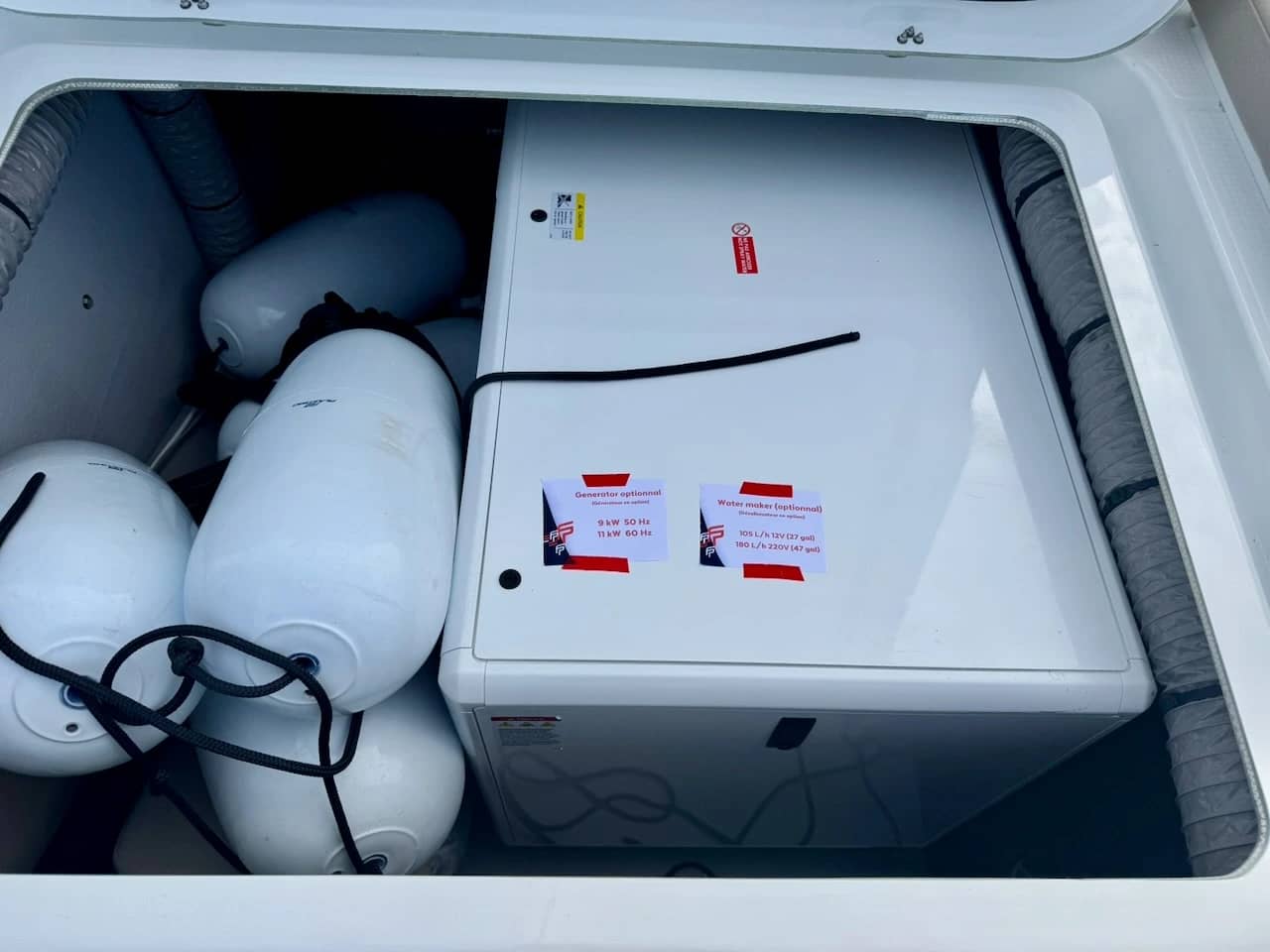
Instead of letting that spare energy go to waste, Integrel harvests it. So while you’re leaving the anchorage or cruising slowly to the next bay, the two Integrel units on MOJO are quietly generating up to 9 kW each – theoretically 18 kW total, realistically around 12–15 kW.
With this setup, we can fully recharge our 30 kWh battery bank in roughly two hours – without ever starting a separate generator.
Criticism and real-world feedback
Of course, Integrel isn’t without controversy. There have been reports of teething issues, installation hiccups and Yanmar warranty disputes over modified engines. Integrel now offers its own insurance to cover such cases.
Users whose systems are working properly are enthusiastic, and one thing keeps coming up: Integrel’s customer support is said to be exceptionally responsive and genuinely committed to solving problems – which, in the marine world, already puts them in a rare category.
Our setup and energy profile
Our expected daily consumption is around 10–20 kWh – depending on crew size, how long the air conditioning runs, cooking, laundry and (yes) hair-drying.
Most of that we’ll cover with solar. When the weather doesn’t cooperate or consumption spikes, an hour of engine time will top up our battery bank by about 50 %.
That should let us stay off-grid for 3–4 days on average – all without a generator.
We’re curious to see how this setup performs in real life and will report back here (and on YouTube) once MOJO is underway.
Further reading: